- Tjeerd Hendel-Blackford

- Last Updated: December 16, 2025
- What makes software implementations hard?
- How to Make Software Implementations EASY! (or easier)
In this article, we review the challenges that come with EHS software implementations and the keys to accomplishing a stress-free and successful implementation.
He walked out in front of the crowd. There were hundreds (nay thousands!) of grizzled, wisened, battle-hardened EHS professionals in the vast arena. All their eyes were on him.
Expectant faces.
Waiting.
You could have heard a pin drop…
And then he spoke.
And they listened…
”Foresooth! For Cority is the best EHS software in the land, and you shall implement it, and everyone in ACME Inc. will be smiling and your LTI rates will tumble around you! Software implementations are a breeze – easy peesy!”
And the crowd erupted into a thunderous ecstatic applause, and it started to rain rose petals, and a passing high-altitude-cruising creature of the porcine variety turned its head down from 10,000 feet up to see what all the noise was down below…
What a load of crap Tjeerd, stop over-dramatising, what really happened?
Fair enough. You got me. What really happened is that I was speaking at a safety conference in Amsterdam recently – and after I’d stumbled up the steps and dealt with the mic-issue, I asked a room of 100 fresh-faced, smart and like-minded EHS professionals if they’d ever been involved in an EHS software implementation…
I’d have put the number of arms raised at over 90.
I then went on to ask how many of those people had found the experience an easy one. There were no rose petals. The two hands that were raised were accompanied by a few groans and a few titters from the rest of the folks in the room.
Conclusion: there are rare exceptions – but implementing EHS software is hard.
What makes software implementations hard?
Now I am in EHS software sales. It’s my job to convince people to sign up to our (admittedly, amazing) market-leading CorityOne platform. I could have stood on that stage and talked about the wonderful seamless implementation process you would have with Cority, or any other EHS software system, and that you’ll get that promotion to Chief EHS Officer as a result – but this is simply not true and most importantly – not going to help you be successful.
Organisations are complex. Humans are complex. There are so many personalities, stakeholders, processes, “ways of doing things”, economic considerations and cultural perspectives (etc, etc, etc) in any organization and all of these will swiftly come bubbling to the top when you start a software project.
But don’t just take it from me: According to Gartner, software implementations (of all types, not specifically EHS) can have failure rates exceeding 75%.
Meanwhile, global consultancy McKinsey estimates that more than 70% of all digital transformations fail.
These are staggering numbers.
So let me restate my earlier conclusion in a different way – Business Transformation is Hard.
Well, I hear you say, thanks for pointing out the obvious – now what are you going to do about it – and what is the point of this article?
Impatient crowd today!
How to Make Software Implementations EASY! (or easier)
OK… what I would like to get across in this article are the key elements that can make your implementation as successful and smooth as possible.
There will always be bumps in the road, but you can look to flatten many of those in advance.
So, what might those bumps, or potholes, be? The most frequent issues we see on projects can be summarized as follows:
- Lack of a strong and clear “WHY?” – not strong executive sponsorship to push the change.
- Too much focus on software functionality and not enough project planning.
- Insufficient resource allocation.
- Lack of consultation of key stakeholders
- IT standards are ignored during selection.
- Lack of strong project management to control expectations, scope, schedule & budget.
- Insufficient support and sustainment after go-live?
- Inadequate uptake/change management
We know this as the voice of experience. We’ve seen it all, or most of it (has anyone ever seen it all?!).
Want to drive employee engagement in EHS? Check out our eBook, Employee Engagement: The Key to Better EHS
The keys to success
Cority has done literally thousands of software implementations and we are proud of our success record.
At any given time, we will have dozens of projects on the go and our PMO carefully manages all of these to spot issues and get them addressed in advance or as soon as identified.
Here is an extract from our PMO dashboard from last year:
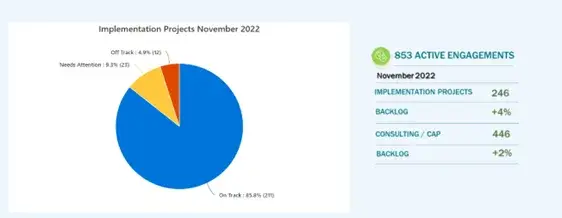
We are very proud that there is relatively very little red and amber. It’s inevitable that there will be some projects off-track or needing attention – but how can you avoid those projects being yours?
The first ingredient for success is of course the software and the functionality it brings. Our vision is that having a true-Saas platform – based on configurability and not custom code – is critical to this. Software needs to be flexible to meet your end-goals and adapt to your organization – but it also needs to reflect industry best practice and efficiencies (what is the most efficient incident management workflow?). This means there must be a natural meeting place somewhere in the middle… flexibility in the software, and flexibility in terms of how things are done at your organization. This I would identify as the second key ingredient – be prepared to challenge how you do things today.
Once you’ve picked the right software (CORITY! – sign up here!), the other ingredients of success that need to be stirred into the pot, in different varying quantities depending on the need, are as follows:
- The Right Project Team & Stakeholders. Getting the right people, with the right technical and subject matter knowledge on the project team is crucial – as is ensuring they have adequate support, time, and resources for the project.
- Governance and Sponsorship. Make it clear who is in charge and who is ultimately responsible for project success at the board level. Having clear escalation paths is vital so that key decisions are made quickly, and effectively and with the necessary authority.
- Detailed Scope & Project Plan. Planning in advance is key as the project plan will guide the timeline and deliverables of the project. Expectations will be set and resource allocation based on this. A clear, mutually defined Statement of Work with documented stages is the guide for the whole project.
- Knowledge of Software Implementation Techniques & Experience with Similar Projects. Having a project team that has done it before cannot be overstated.
- Integration Experience. Most companies will want their software to connect with other existing systems or migrate/import data. These can be the most complex and problematic parts of the project and having relevant expertise and knowledge are fundamental.
- Roadmap Knowledge. Having knowledge of the functional enhancements planned for your Saas software solution is important as they will factor into the project plan and getting the timing right on these can impact project decisions and approach.
- Change Management Techniques. Arguably one of the most important elements. How will adoption of your new solution be driven withing your organization? Involving internal communications and change management professionals will be fundamental to your success. Starting small with a simpler, more easily adopted solution is also highly recommended.
In conclusion, I would summarise the key takeaways as follows:
- Business transformation and, more specifically, EHS software implementation is hard. But having the right team of subject matter experts and appropriate buy-in from key stakeholders is a key ingredient to successful implementations.
- Choosing the right software that can grow with your company and complement current processes and workflows is crucial for prolonged success after go-live.
- Being flexible, adaptable, and open to change will alleviate some of the stress and open the door to vast improvements and different ways of thinking.
[optin-monster-inline slug=”qf1rhqjpo43wsum8csxt”]
- Explore Related Topics
- Digital Transformation, EHS+, Software Configurability, Software Implementation, Software Scalability
We value your privacy

Tjeerd Hendel-Blackford
Tjeerd is an experienced Sales Leader covering the EMEA and APAC regions. He and his team work to build long-term strategic partnerships with new and existing customers to help them reach and exceed their EHS and ESG/Sustainability goals. Tjeerd has over two decades of experience in environment, health & safety, and quality (EHSQ). Having worked as both an EHS practitioner and a consultant he has helped dozens of companies to address their HSEQ challenges through the application of management best practice in combination with market-leading information and technology solutions.