- Stuart Cook

- Last Updated: May 6, 2026
- Defining Applied AI
- Why Applied AI is Different
- Real Value for EHS Teams
- The Future of Applied AI in EHS
Environmental, Health, and Safety (EHS) programs are at a crossroads. Long reliant on manual processes and reactive measures, organizations are moving towards an era transformed by applied artificial intelligence (AI).
But what do we mean when we say “applied AI” in the context of EHS? And how is it reshaping the way organizations work in highly regulated industries, from manufacturing to utilities and chemicals?
Defining Applied AI
Artificial Intelligence (AI) is a broad term that often feels abstract, and it’s everywhere. You’ll see it mentioned in everything from your favorite music streaming application to the technology behind self-driving cars. So, when we talk about Applied AI, especially within the context of EHS, the concept becomes much more practical.
Cority defines Applied AI as the application of real-world examples of AI into standardized workflows. In other words, it’s about taking proven AI capabilities and embedding them into everyday EHS processes to deliver tangible value.
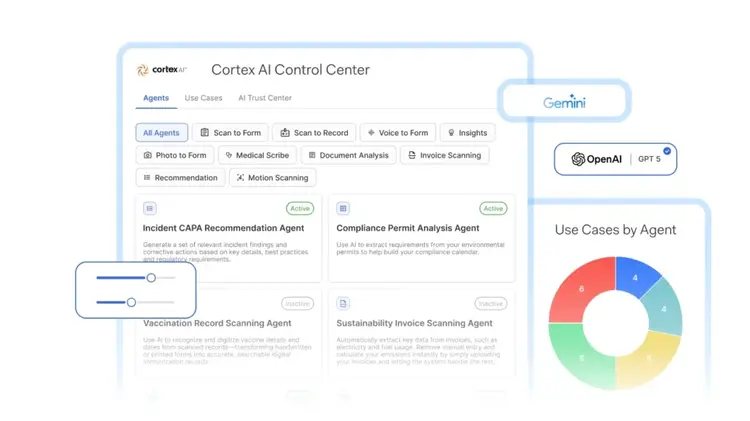
This distinction matters because not only can AI mean a million things in a million contexts – but it sometimes struggles to show value in the real world. Predictive analytics, generative models, and automation all fall under the AI umbrella, but not every use case translates into meaningful improvements for EHS teams.
Applied AI narrows the focus to solutions that integrate seamlessly with existing systems and workflows, helping organizations solve real problems like reducing risk, improving compliance, and streamlining reporting.
Why Applied AI is Different
While the promise of AI often sounds futuristic, Applied AI brings with it a grounded sense of practicality. It’s not about replacing human judgment or creating complex systems that require months of training. Instead, it’s about enhancing what EHS professionals already do by embedding AI into tools they use every day.
For example, rather than manually analyzing thousands of incident reports, Applied AI can be used to automatically surface patterns and insights, saving EHS professionals considerable time, and often improving the accuracy of their findings.
Similarly, predictive models can help anticipate where risks are most likely to occur, enabling human users with proactive steps to introduce interventions before incidents happen.
Real Value for EHS Teams
Applied AI delivers value because it works within the context of standardized workflows. This means EHS professionals don’t need to reinvent their processes or adopt entirely new platforms. Instead, AI capabilities are integrated into familiar systems, making them easier to adopt and more effective in practice.
For instance, AI can assist with data validation during inspections, flag anomalies in real time, and even generate summaries for leadership reports. These enhancements reduce administrative burdens and allow teams to focus on strategic safety initiatives.
The Future of Applied AI in EHS
As organizations continue to prioritize safety and sustainability, Applied AI will play an increasingly important role.
That’s why we developed Cortex AI, the future of intelligent EHS workflows, delivering predictive insights and automation that empower professionals to work smarter and safer.
By embedding AI into core workflows, companies can move from reactive to proactive risk management, improve compliance, and create safer workplaces. The key is to focus on practical applications that deliver measurable outcomes rather than chasing abstract concepts.
Applied AI isn’t about what’s possible in theory; it’s about what works in practice. Learn more about Cortex AI.

- Explore Related Topics
- AI for EHS, EHS Management, Sustainability & ESG, Workplace Safety
We value your privacy
Stuart Cook
Stu Cook is a Product Marketing Manager supporting Cority’s Analytics and Platform solutions. Having worked for nearly 10 years in a variety of marketing and user-focused technology roles, Stu enjoys learning about and improving technology that enables data-driven decision making and simplifies processes for EHS professionals.